
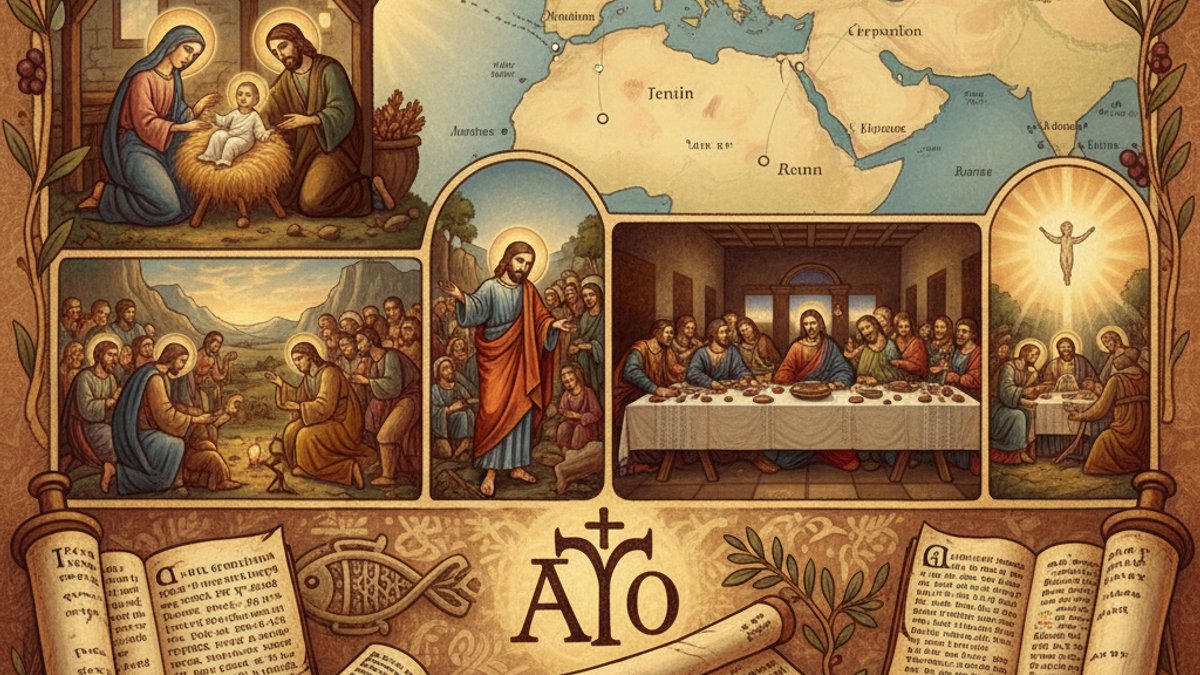
The New Testament (NT) constitutes the second and final section of the Christian Bible, a collection of 27 canonical books written predominantly in Koine Greek. Its primary purpose is to document the life, teachings, sacrificial death, and resurrection of Jesus Christ, as well as the establishment and expansion of the early Church. It serves as the divinely inspired record of God's New Covenant with humanity, offering guidelines for Christian faith and practice.
Understanding the New Testament is intrinsically linked to the Old Testament (OT). Far from being an annulment, the NT represents the fulfillment of divine promises and prophecies contained in the OT, fully revealing God's redemptive plan. The laws, rituals, and narratives of the OT point to the coming of a Messiah, whose identity and work are fully revealed in Jesus Christ, establishing a fundamental continuity in the history of salvation.
In this context, Jesus Christ is the central figure and the unifying link of the entire New Testament. All of its books—whether the Gospels that narrate His life, Acts that record the propagation of His message, the Epistles that elucidate their theological implications, or Revelation that envisions His final triumph—converge on the person and work of Christ, who is the hermeneutical key to interpreting the totality of biblical revelation and the foundation of Christian faith.
The New Testament (NT) is a collection of 27 distinct books, written by different authors over a period of approximately 50 to 100 years after the death and resurrection of Jesus Christ. Together, they form the second part of the Christian Bible, serving as the authoritative record of Jesus' life, the birth of the Church, and the fundamental doctrines of the Christian faith. Understanding its composition and structure is essential for appreciating its theological richness and cohesion.
Despite its diversity, the NT is categorized into five main sections, each with its own focus and purpose.
Composed of Matthew, Mark, Luke, and John, the Gospels narrate the life, ministry, teachings, miracles, death, resurrection, and ascension of Jesus Christ. Matthew, Mark, and Luke are the "Synoptic Gospels" due to their similarities in content and structure, allowing them to be "seen together." John, in turn, presents a distinct theological perspective, focused on the deity of Christ and on longer, more profound discourses.
Written by the same author as Luke, the book of Acts serves as a narrative bridge between the Gospels and the Epistles. It details the ascension of Jesus, the outpouring of the Holy Spirit at Pentecost, the birth and expansion of the early Church, and the evangelistic mission of the apostles, with a focus on Peter and Paul in spreading the Gospel from Judaism to the Gentile world.
This collection includes thirteen letters (or fourteen, if Hebrews is attributed to Paul, though its authorship is debated) written by the Apostle Paul to various Christian communities and individuals. They are traditionally grouped into: Major Epistles (Romans, 1 and 2 Corinthians, Galatians), Prison Epistles (Ephesians, Philippians, Colossians, Philemon), and Pastoral Epistles (1 and 2 Timothy, Titus). The Pauline Epistles are rich in theology, ethical exhortations, and practical guidance for Christian life.
Composed of Hebrews (authorship uncertain), James, 1 and 2 Peter, 1, 2, and 3 John, and Jude, these seven letters are called "General" or "Catholic" (universal) because they are not addressed to a specific congregation, but to a broader Christian audience. They address a variety of doctrinal, ethical, and pastoral themes, reinforcing faith and conduct amidst challenges and heresies.
The last book of the New Testament, Revelation, is a work of apocalyptic genre, written by John. Characterized by symbolic visions, it offers a message of hope and encouragement to persecuted Christians, prophesying Christ's final victory over evil and the establishment of His eternal Kingdom.
The inclusion of these 27 books in the New Testament canon was a gradual process of recognition by the early Church, lasting several centuries. Criteria for acceptance included: apostolic authorship (direct or indirect), widespread acceptance and use by the churches, orthodoxy (conformity with established Christian faith), and divine inspiration. Canonical lists emerged in the 2nd century (such as the Muratorian Canon). Athanasius of Alexandria, in the 4th century, presented the complete list of 27 books we know today, which was confirmed by the Councils of Hippo (393 A.D.) and Carthage (397 A.D.). The Church, therefore, did not "create" the canon, but discerned the inherent authority of these inspired writings.
Understanding the New Testament requires a deep immersion into the cultural, political, and religious melting pot of the 1st century A.D. This period of intense transformations and tensions formed the indispensable backdrop for the emergence of Christianity. Palestine, a crossroads of empires, and the vast influence of Greco-Roman culture shaped the communities and mindsets that would receive and transmit the message of Jesus Christ and the apostles.
In the 1st century A.D., the region of Judea was under Roman rule, established by Pompey's conquest in 63 B.C. At the time of Jesus, Judea was administered by Roman procurators such as Pontius Pilate, known for his role in Jesus' trial, while other regions, like Galilee, were governed by client kings, such as Herod Antipas. Roman presence manifested itself in heavy taxation, military garrisons, and the imposition of an imperial order that often clashed with Jewish religious and cultural sensitivities. This foreign subjugation generated a messianic longing for political and religious liberation among many Jews, an expectation that became fertile ground for the message of a "Kingdom of God."
1st century Judaism was not a monolithic movement, but rather a complex mosaic of groups with distinct beliefs and aspirations, all seeking to live their faith under the Torah. The Pharisees were an influential and popular group, known for their strict observance of the Law (written and oral Torah) and their belief in the resurrection of the dead. Their authority was exercised primarily in the synagogues and among the common people. In contrast, the Sadducees represented the priestly aristocracy, held power in the Temple of Jerusalem, and were more theologically conservative, rejecting resurrection and oral tradition. They were more inclined to collaborate with the Roman administration to maintain their status quo. The Essenes were an ascetic and separatist group, living in isolated communities (like Qumran, associated with the Dead Sea Scrolls), focused on ritual purity and apocalyptic expectations. Finally, the Zealots were fervent nationalists who advocated for the liberation of Israel from Roman rule through armed resistance, rejecting any sovereignty other than that of God. The interaction of Jesus and the early Christians with these groups reveals the tensions and theological debates of the time.
Although Palestine maintained its Jewish identity, it was not immune to the profound influence of Hellenism, the Greek culture that had spread throughout the world after Alexander the Great's conquests (4th century B.C.). Koine Greek was the lingua franca of the eastern Mediterranean, used in commerce, administration, and, crucially, in the composition of the New Testament itself. Hellenistic cities, such as Caesarea Maritima and Decapolis, dotted the region, bringing with them gymnasiums, theaters, and philosophies that challenged Jewish traditions. The Roman administration, in turn, imposed its own material and legal culture, with roads, imperial temples, and an omnipresent legal system. This cultural fusion (Hellenism + Romanization) generated both opportunities and challenges. Many Diaspora Jews had assimilated aspects of Hellenism, but in Judea, resistance to elements considered pagan was strong. The New Testament reflects this complexity, dialoguing with both Jewish tradition and the vast Greco-Roman world.
The books of the New Testament were not written immediately after the events they narrate, but rather over a period of approximately 50 to 100 A.D. The epistles of the Apostle Paul are generally considered the earliest writings, dating from the 50s and 60s A.D., reflecting the issues and challenges of the first Christian communities. The Synoptic Gospels (Mark, Matthew, and Luke) were likely redacted between 60 and 85 A.D., each presenting the life and ministry of Jesus from a distinct theological perspective for its community. The Gospel of John and the book of Revelation are generally dated to the latter part of the 1st century (90s A.D.), reflecting the consolidation of Christian identity and the experience of persecution under the Roman Empire. The destruction of the Temple of Jerusalem in 70 A.D. by Roman forces was a cataclysmic event that profoundly influenced the theology and eschatology of early Christians and Jews, marking a significant reorientation in the understanding of worship and divine presence. Knowing this period of composition helps to understand the concerns of the authors, the original recipients, and the evolution of early Christian theology.
Understanding the authorship and dating of the New Testament books is fundamental to correctly interpreting their messages and situating them within their historical and theological context. While ecclesiastical tradition provides authorship attributions that have been widely accepted for centuries, modern scholarship applies historical and critical methods to reexamine these questions, revealing a more complex and nuanced scenario.
Traditionally, the 27 books of the New Testament are attributed to a relatively small group of individuals, many of whom were apostles or their direct associates:
Contemporary biblical scholarship, based on textual, historical, and literary analysis, often questions or refines traditional attributions:
The dating of the New Testament books is also crucial for understanding their theological and historical development. The dates are estimates and may vary slightly among scholars:
It is fundamental to note that all New Testament books were originally written in Koine Greek (κοινή), the common form of Greek spoken in the Eastern Roman Empire during the Hellenistic and Roman periods. It was not classical literary Greek, but the everyday lingua franca, making the texts accessible to a vast population that went beyond Jewish communities. This choice of language underscores the universal intent of early Christianity and its rapid dissemination.
In short, the authorship and dating of the New Testament are dynamic fields of study that enrich our understanding of the process by which these sacred texts were formed and transmitted. While tradition guides us, academic inquiry invites us to a deeper appreciation of the complexity and rich history behind each book.
The reliability and integrity of the New Testament we have today are intrinsically linked to its fascinating history of textual transmission. Far from being an accidental process, the preservation of the original texts occurred through the diligent copying of manuscripts over the centuries, a historical and documented process that textual criticism rigorously examines.
The earliest New Testament documents were written on papyrus, a material made from plant fibers predominant in Egypt. The discovery of these papyri in the 19th and 20th centuries revolutionized our understanding of the antiquity and circulation of apostolic texts. Among the most significant are:
These papyri are crucial witnesses to the rapid dissemination and initial preservation of the New Testament texts.
Over time, papyrus was replaced by parchment (animal skin) and the scroll format by the codex (bound book), which was more durable and practical. The great majuscule codices (written in continuous capital letters) of the 4th and 5th centuries form the backbone of New Testament textual criticism:
Together, these codices provide an essential comparative basis for the reconstruction of the text.
The quantity of textual evidence for the New Testament is unprecedented in antiquity. Currently, we have more than 5,800 Greek manuscripts in existence, in addition to approximately 10,000 Latin Vulgate manuscripts, thousands in other ancient languages (Syriac, Coptic, Armenian, etc.), and tens of thousands of citations from the Church Fathers. This vast wealth of data allows for exhaustive cross-referencing and unparalleled confidence in its transmission.
Naturally, with so many manual copies, variations arise—most are scribal errors (spelling, accidental omissions, transpositions) and a few are intentional alterations. Textual criticism is the academic discipline that compares these variations to reconstruct the original text with the highest possible probability. Using rigorous methods, textual critics evaluate criteria such as the antiquity and quality of the manuscripts, the geographical distribution of variants, and the likelihood that one reading gave rise to the others. The academic consensus is that the text of the New Testament has been transmitted with a remarkable degree of fidelity, and the few significant differences do not impact any fundamental Christian doctrine, ensuring that the essential message remains intact and accessible.
The New Testament is a rich tapestry of theological concepts that intertwine to present the central message of Christianity. Understanding these themes is fundamental to grasping the depth and relevance of the Christian faith, revealing God's redemptive plan for humanity.
At the heart of the New Testament is Christology, the study of the person and work of Jesus Christ. The gospels and epistles consistently affirm His dual nature: fully God and fully man. As God, He is the eternal Word (John 1:1), the only begotten Son, sharing the essence of the Father. As man, He was born of Mary, experiencing human life in its totality (Philippians 2:6-8; Hebrews 4:15). This union is crucial, for only the God-Man can effect redemption, serving as the perfect high priest and atoning sacrifice. Titles such as "Lord," "Messiah/Christ," and "Son of Man" underscore His sovereignty, His promised identity, and His solidarity with humanity.
Salvation, humanity's deliverance from sin and death, is another central theme. The New Testament emphasizes that this salvation is entirely a gift from God, granted by His grace (Ephesians 2:8-9). It is not achieved by human works, but received by faith in Jesus Christ. Through His sacrificial death on the cross, Christ paid the price for sin, and His resurrection guarantees victory over death. God's grace not only forgives but also transforms, enabling believers to live a new life in righteousness. Concepts such as justification (being declared righteous by God), redemption (being bought back), and reconciliation (restoration of relationship with God) are fundamental to understanding the scope of salvation.
The Kingdom of God was the central theme of Jesus' preaching, referring to God's sovereign rule. The New Testament presents the Kingdom as an "already and not yet" reality: already present in the person and work of Jesus (healings, teachings) and in the lives of His followers; but not yet fully consummated, awaiting Christ's return. This theme challenges believers to live according to the values of the Kingdom—justice, love, and righteousness—anticipating its glorious coming.
Born at Pentecost, the Church is the community of those called to follow Christ. It is the "body of Christ" (Ephesians 1:22-23), with Christ as the head and believers as members. The Church is both local and universal, with the purpose of worshiping God, building up its members through fellowship and teaching, and fulfilling the "Great Commission" to proclaim the gospel. Life in community is essential, characterized by mutual love, service, and the use of spiritual gifts, reflecting the unity and diversity of God's people.
Eschatology, the study of the "last things," permeates the New Testament, instilling hope and urgency. It includes the second coming of Christ (the Parousia), the resurrection of the dead, the final judgment, and the establishment of new heavens and a new earth. While there is mystery and diverse interpretations, the central message is clear: God will fulfill all His promises, and evil will ultimately be defeated. This future hope shapes believers' present lives, calling them to vigilance, holiness, and a continuous commitment to God's mission.
A crucial aspect of the New Testament is its demonstration of how Jesus Christ and the events of His life, death, and resurrection fulfill the prophecies and typological patterns of the Old Testament. The New Testament frequently quotes or alludes to the Old Testament to show that Jesus is the promised Messiah (Matthew 1:22-23; John 5:39), the Suffering Servant (Acts 8:32-35), the prophet like Moses, and the king of David's lineage. This interconnection underscores the continuity of the divine plan, revealing God's faithfulness to His covenant and the culmination of His redemptive history in Christ. The Old Testament sets the stage; the New Testament presents the realization.
The New Testament is not a monolithic book, but a collection of diverse writings, each with its own literary form and purpose. Understanding the literary genres present is crucial for a correct and enriching interpretation of its messages. Identifying the genre helps us understand the author's intentions and the way information is presented.
The four Gospels—Matthew, Mark, Luke, and John—constitute the core of the New Testament and are classified as biographical narratives of Jesus Christ. They are not modern biographies, but present His life, ministry, teachings, death, and resurrection with a theological purpose. They are selective, focusing on events and words that reveal Jesus' identity as the Messiah and Son of God, inviting the reader to faith and discipleship. Each Gospel offers a unique perspective, employing parables, miracles, and discourses to construct its narrative.
The Epistles, or letters, make up the majority of the New Testament, written by apostles such as Paul, Peter, John, James, and Jude, addressed to churches or individuals. This literary genre, common in the Greco-Roman world, follows a basic structure of greeting, thanksgiving, body of the letter (theological development and ethical exhortation), and closing. The Epistles address a wide range of themes: doctrinal instruction, correction of errors, encouragement amidst persecution, and practical guidance for Christian life, always contextualized to the needs of their first readers.
The last book of the New Testament, the Revelation to John, represents a distinct literary genre: the apocalyptic. Characterized by symbolic visions, vivid imagery, and the presence of angelic messengers, this genre seeks to reveal heavenly realities and God's sovereign plan for history. Written in a context of persecution, Revelation offers hope and encouragement to the faithful, demonstrating God's final victory over evil and the consummation of His kingdom. Its interpretation requires care to decipher its symbolism and avoid inappropriate literalizations.
By recognizing and respecting the particularities of each genre, the reader is empowered to approach the text with correct expectations, allowing the original message of the New Testament authors to be understood in its fullness and impact.
The New Testament is not just a collection of ancient texts; it is, in fact, the cornerstone of Christianity. In it, we find the record of the life, ministry, death, and resurrection of Jesus Christ, the central figure for the Christian faith. The Gospels (Matthew, Mark, Luke, and John) offer eyewitness and theological testimonies of these crucial events, while the Acts of the Apostles narrate the birth and expansion of the Early Church. The Pauline and general epistles develop Christian theology, outlining essential doctrines about salvation, the nature of God, ethics, and community life, providing the basis for the faith, practice, and morality that define billions of followers worldwide. The divine authority and inspiration attributed to these writings solidify the New Testament as the normative voice for Christian faith and conduct.
Beyond its theological function, the impact of the New Testament transcends religious boundaries, profoundly shaping Western and global history and culture. Its narratives, characters, and teachings have permeated art, literature, music, and philosophy for millennia, from medieval cathedrals to modern literature. Concepts such as love for neighbor, forgiveness, social justice, and the intrinsic dignity of the human being, while not exclusive, were catalyzed and widely disseminated by its message, influencing legal, ethical, and social systems. Even in secular societies, New Testament values and archetypes persist, dialoguing and provoking reflection. Its perennial relevance lies not only in its capacity to inspire faith but also in its continuous power to challenge and transform perspectives on humanity and the purpose of life.