
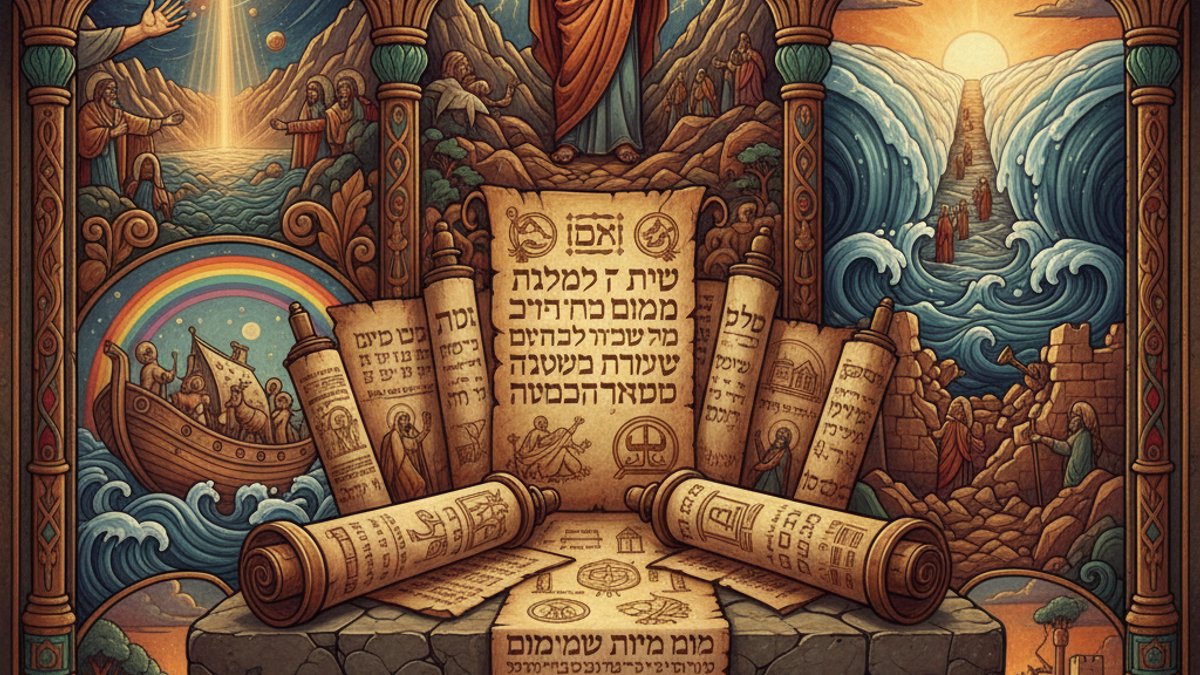
The Old Testament, the first and most extensive part of the Christian Bible, constitutes a fundamental compendium of sacred texts spanning millennia of history and divine revelation. Known in Judaism as the Tanakh (an acronym for Torah, Nevi'im, and Ketuvim), it is the bedrock of Jewish faith, outlining God's covenant with Israel, the Mosaic Law, and the narrative of a chosen people. For Christianity, the Old Testament is the theological and prophetic foundation of the New Testament, revealing God's character, His promises, and the preparation for the coming of Jesus Christ as Messiah, being indispensable for understanding the history of salvation.
Composed of diverse literary genres, the Old Testament begins with the Pentateuch (Genesis to Deuteronomy), which narrates creation, the Fall, the Flood, the patriarchs, and the formation of Israel as a nation. The historical books follow, describing Israel's journey in the Promised Land, its kings, and prophets. Wisdom and poetic literature (such as Psalms and Proverbs) offers profound reflections on life and faith, while the prophetic books proclaim divine messages of warning, hope, and messianic foreshadowings. This rich textual mosaic is crucial for understanding the roots of the Abrahamic faith.
The Old Testament is not a singular book, but rather a vast and complex collection of writings that were compiled over approximately a thousand years, forming the first part of the Christian Bible. Its composition reflects a rich tapestry of literary genres, stories, laws, poetry, and prophecies, united by a central theological narrative that points to the sovereignty of God, the history of His people Israel, and His covenant with humanity. The canonical structure, although presenting variations among religious traditions, generally organizes these books into main thematic divisions, facilitating the understanding of their development and message.
In the Protestant canon, the Old Testament is composed of 39 books, traditionally divided into four main categories, which help to trace the flow of salvation history and divine revelation:
Also known as the Pentateuch (five scrolls) or the Law, this section comprises the first five books: Genesis, Exodus, Leviticus, Numbers, and Deuteronomy. It serves as the foundation of the entire Old Testament, narrating the creation of the world, the Fall of humanity, the history of the patriarchs (Abraham, Isaac, Jacob), the Exodus of Israel from Egypt, the giving of the Law on Mount Sinai, and the journey through the wilderness to the border of Canaan. The Torah establishes the principles of God's covenant with Israel and the foundations of their faith and practice.
This category includes twelve books that continue the narrative of Israel's history after the death of Moses. It covers the conquest of Canaan (Joshua), the period of the Judges, the establishment of the monarchy (Samuel and Kings), the division of the kingdom, the exile in Babylon, and the return to Jerusalem (Chronicles, Ezra, Nehemiah, Esther). These books document Israel's faithfulness and unfaithfulness to the covenant, the consequences of their choices, and God's continuous intervention in their history.
Comprising Job, Psalms, Proverbs, Ecclesiastes, and Song of Songs, this section offers a deep exploration of human experience, divine wisdom, and the nature of faith. They address existential, moral, and ethical questions through poetry, songs, and practical teachings, revealing God's wisdom applicable to daily life and worship.
The seventeen prophetic books are divided into Major Prophets (Isaiah, Jeremiah, Lamentations, Ezekiel, and Daniel) and Minor Prophets (the twelve books from Hosea to Malachi). These books contain God's messages transmitted by His spokespersons to the peoples of Israel and Judah, and to neighboring nations. They call the people to repentance, denounce social injustice, proclaim divine judgment, and offer hope of restoration and the coming of a Messiah.
It is fundamental to note that the number of books in the Old Testament differs among the main Christian traditions. While the Protestant canon contains 39 books, the Roman Catholic canon includes 46 books. This difference lies in the inclusion of seven additional books, known as deuterocanonical or apocryphal (Tobit, Judith, Wisdom, Ecclesiasticus/Sirach, Baruch, 1 and 2 Maccabees, as well as additions to Esther and Daniel), which were part of the Septuagint (the Greek translation of the Old Testament) but not of the original Hebrew canon. Eastern Orthodox churches, in turn, generally accept an even greater number of books, such as 3 and 4 Maccabees and Psalm 151. These variations reflect different historical and theological processes in the formation of the canons, but the essence of God's covenant message and His historical revelation remains central in all traditions.
To uncover the depth and relevance of the Old Testament, it is indispensable to place it within its vast and complex historical and chronological context. This collection of sacred books reflects centuries of history, theology, and culture of the Ancient Near East, shaped by momentous events and interactions with powerful civilizations.
The writing and compilation of the Old Testament span a long temporal arc, covering approximately 1200 B.C. to 100 B.C. Although some oral traditions and narratives have older roots, the final form of the texts – including laws, prophecies, poetry, stories, and wisdom – was established and edited by various generations of scribes and theologians, who interpreted the history of Israel in light of their faith and their own historical experiences.
The narrative of the Old Testament is woven through seminal events that defined Israel's identity:
Patriarchal and Egyptian Period (c. 2000-1300 B.C.): Foundational stories of the patriarchs Abraham, Isaac, and Jacob, culminating in the migration and subsequent enslavement of their descendants in Egypt.
The Exodus and the Wilderness Wanderings (c. 13th century B.C.): Central event: liberation from Egyptian slavery under Moses, the reception of the Law on Mount Sinai, and the formation of Israel's identity in the wilderness.
The Conquest of Canaan and the Judges (c. 1200-1050 B.C.): Entry and establishment in Canaan under Joshua, followed by a period of tribal confederation and charismatic leaders (Judges) in times of crisis.
The United Kingdom (c. 1050-930 B.C.): Formation of the monarchy with Saul, David, and Solomon. David establishes Jerusalem as the capital; Solomon builds the First Temple, marking a golden age.
The Divided Kingdoms (c. 930-586 B.C.): After Solomon, the kingdom divides into Israel (North) and Judah (South). Israel falls to Assyria (722 B.C.); Judah is conquered by Babylon (586 B.C.), resulting in the destruction of Jerusalem and the Temple.
The Babylonian Exile (586-539 B.C.): The Judean elite is forcibly exiled to Babylon. This period of deep crisis prompts reflection and preservation of Israel's traditions.
The Return and the Post-Exilic Period (539-c. 330 B.C.): With the rise of the Persian Empire, Cyrus the Great permits the return. The Second Temple is rebuilt, and Jerusalem restored, solidifying the foundations of post-exilic Judaism.
Hellenistic and Maccabean Period (c. 330-63 B.C.): Greek influence (Hellenism) spreads after Alexander the Great. Resistance to forced Hellenization leads to the Maccabean Revolt and the finalization of some Old Testament works.
Israel's interactions with great powers of the Ancient Near East are crucial for the Old Testament: Egypt (Exodus period), Assyria (fall of the Northern Kingdom), Babylon (exile of Judah), Persia (return of the exiles), and Greece (Hellenistic influence). Other civilizations, such as Canaanites, Philistines, and Arameans, also shaped the regional context, influencing conflicts and cultures.
Understanding this rich tapestry of historical events and cultural interactions not only illuminates the narratives of the Old Testament but also reveals the evolution of Israel's faith and identity in a constantly changing world.
The Old Testament, a collection of books revered for millennia, did not emerge all at once, but is the product of a complex and multifaceted process of composition, editing, and transmission that spanned many centuries. Understanding its formation is crucial for appreciating its richness and theological depth, revealing how Israel's faith and history were recorded and preserved.
Before being committed to writing, many of the stories, laws, songs, and prophecies that comprise the Old Testament were transmitted orally for generations. In ancient Near Eastern cultures, collective memory and communal repetition were powerful mechanisms for preserving knowledge and identity. Narratives about creation, the patriarchs, the Exodus, and the covenant with God circulated and were retold, shaped, and enriched over time, ensuring that the central events and teachings were kept alive in the consciousness of the people of Israel. This oral phase not only prepared the ground for writing but also influenced the structure and narrative style of many parts of the Hebrew Bible.
The vast majority of the Old Testament was written in Biblical Hebrew (or Classical Hebrew), a Semitic language. This Hebrew possesses a rich vocabulary, peculiar grammatical structure, and a poetic way of expressing ideas, which is reflected in the literary beauty of many texts. However, some sections, notably parts of the books of Ezra (4:8-6:18; 7:12-26) and Daniel (2:4b-7:28), as well as a single phrase in Genesis 31:47 and in Jeremiah 10:11, were written in Aramaic. Aramaic, also a Semitic language, was the lingua franca of the Ancient Near East during certain periods and became the spoken language of the Jews after the Babylonian exile.
Traditionally, the authorship of many Old Testament books was attributed to specific figures: Moses to the Pentateuch, David to a large part of the Psalms, Solomon to Proverbs, Ecclesiastes, and Song of Songs, and the prophets to their respective books. This view was widely accepted for centuries. However, starting from the Enlightenment period, modern textual criticism began to question these attributions, based on internal evidence from the texts themselves. Linguistic variances, repetitions of stories with different emphases, anachronisms, and distinct theological perspectives led scholars to propose that many books are, in fact, compilations or the product of multiple authors and editors who worked over time.
One of the most prominent examples of modern criticism is the Documentary Hypothesis, applied mainly to the Pentateuch (the first five books of the Bible). This theory proposes that the Pentateuch was not written by a single author but is a fusion of at least four main, distinct, and independent sources that were composed at different times and then interwoven by editors:
Although subject to continuous debates and refinements, the Documentary Hypothesis offers an influential framework for understanding the complexity of authorship and literary development of the Pentateuch, revealing a formation process that was both gradual and collaborative, reflecting Israel's faith and history throughout the centuries.
Understanding the Old Testament would not be complete without an appreciation of how its texts were preserved and transmitted over millennia. Given the antiquity of the writings, dating back over three thousand years, the question of their textual fidelity is crucial. Fortunately, the meticulous work of scribes and divine providence ensured a remarkably consistent transmission, attested by various manuscript collections.
One of the oldest and most significant textual witnesses to the Old Testament is the Septuagint (LXX), a Greek translation of the original Hebrew. Carried out between the 3rd and 2nd centuries B.C. in Alexandria, Egypt, the LXX served as the Bible for many Diaspora Jews and, crucially, was the Scripture adopted by the Early Church. It offers a window into a form of the Hebrew text predating the Masoretic Text, sometimes revealing important textual variations.
The discovery of the Dead Sea Scrolls in Qumran, starting in 1947, revolutionized biblical studies. Dated between the 3rd century B.C. and the 1st century A.D., these thousands of fragments and scrolls include copies of almost all Old Testament books (except Esther). They filled a thousand-year textual gap, revealing the textual diversity of Hebrew in the pre-Christian era. While confirming the remarkable fidelity of the Masoretic Text, they also demonstrate different textual traditions that coexisted before later standardization.
The Masoretic Text (MT) forms the basis for most Hebrew Bibles and modern translations of the Old Testament. Preserved and standardized by a group of Jewish scholars known as the Masoretes, who were active between the 6th and 10th centuries A.D., the MT represents a meticulously copied and vocalized textual tradition. The Masoretes not only preserved the consonantal text but added vowels, accents, and marginal notes (the Masora) to ensure correct pronunciation and understanding. Their work is a testament to the dedication in safeguarding the purity of the Torah and the Prophets.
The process of textual transmission, although complex, reveals remarkable consistency in the manuscripts throughout the centuries. Variations observed between the Septuagint, the Dead Sea Scrolls, and the Masoretic Text are generally minimal and do not compromise central doctrines. On the contrary, the existence of multiple independent witnesses reinforces confidence in the essential integrity of the Old Testament's divine message, revealing God's divine care in preserving His Word.
The Old Testament is not merely a collection of ancient stories or laws; it is a rich tapestry of fundamental theological truths that shaped the understanding of God and humanity. These central themes provide the lens through which the entire biblical narrative can be understood, revealing God's nature, His purposes for the world, and the journey of His chosen people.
At the heart of Old Testament theology lies radical monotheism: the uncompromising belief in a single God, Yahweh, the Creator and Sovereign of the universe. In stark contrast to the surrounding polytheism, Israel was called to worship and serve exclusively this God. Intimately linked to this uniqueness is the idea of the covenant, a solemn pact established by God. We see the Abrahamic covenant (promises of land, descendants, and universal blessing) and, especially, the Mosaic covenant at Sinai, which formalized Israel as God's people, with specific obligations and privileges. These covenants demonstrate God's initiative in establishing a relationship and His unwavering faithfulness to His commitments.
The giving of the Torah (the Law) on Mount Sinai was not just a set of rules, but the revelation of God's holy and just character and a guide for human flourishing within the covenant. The Law encompassed ritual, civil, and ethical aspects, outlining a way of life that reflected God's holiness. More than mere prohibitions, the Law promoted social justice (mishpat) and righteousness (tsedeq), instructing the people to care for the vulnerable: the poor, orphans, widows, and foreigners. It revealed that God's justice is founded on His very being, and that He expected His people to imitate this justice and righteousness in all their interactions.
A thread of hope and expectation runs through the entire Old Testament: the messianic promise. From the proto-Gospel in Genesis 3:15, speaking of a "seed of the woman" who would crush the serpent's head, to the promises to Abraham of blessing for all nations, and especially to David of a descendant whose throne would be eternal, the expectation of a deliverer and ideal king intensifies. Later prophets, such as Isaiah and Micah, detail a suffering and triumphant Messiah who would bring redemption, justice, and lasting peace. This promise not only provided hope but also gave purpose and meaning to Israel's trials and waitings.
The Old Testament narrative begins with the creation of humanity in God's image, destined for communion. However, sin broke this ideal relationship. Despite human disobedience, God persistently sought to restore and maintain His relationship. This is evidenced by His steadfast love (hesed) and faithfulness, manifested in His covenants, His provision of salvation, and His willingness to forgive repentance. The relationship is dynamic, marked by God's holiness and transcendence, but also by His immanence and profound involvement in human history. The expected human response was faith, obedience, and repentance, showing the tension between divine initiative and human responsibility in maintaining this vital relationship.
Far from being just a collection of ancient texts, the Old Testament maintains a vital and dynamic relevance for Jewish and Christian faiths today. It is not a historical relic, but the undeniable foundation upon which centuries of theology, identity, and religious practice have been and continue to be built.
For Judaism, the Old Testament (or Tanakh) constitutes the backbone of its faith, history, and culture. The Torah, in particular, is divine law and a guide for life. The Prophets and Writings offer wisdom, comfort, and the continuing narrative of God's relationship with His people, keeping alive the memory of the covenant and messianic hope.
For Christianity, the Old Testament is the indispensable basis for understanding the New Testament and the person of Jesus Christ. It reveals the unchanging nature of God — His sovereignty, love, justice, and mercy — establishes the setting for the human condition, sin, and the need for redemption, and details the progress of the divine plan of salvation throughout history.
The connection with the New Testament is intrinsic. Jesus and the apostles frequently quoted and interpreted the Old Testament to explain the identity of the Messiah, the meaning of His work, and the nature of the Kingdom of God. The messianic prophecies, types, and shadows of salvation found in the Old Testament are seen as fulfilled in Christ, offering the essential theological and historical background for a full understanding of the new covenant. Without it, the depth of Jesus' sacrifice and the continuity of divine purpose would be incomplete.
Furthermore, its narratives and laws continue to offer timeless ethical and moral principles, addressing themes such as social justice, care for one's neighbor, faithfulness to God, and the pursuit of a life of righteousness, which remain profoundly pertinent for individual and communal life in modern times.